
Research methodology:
First-hand accounts will be taken from the Bible because they are the only
primary sources available. Mary Magdalene is a popular topic and many academic essays are available to inform my understanding of this fascinating disciple. Scholarly commentary will also be consulted to better understand this lady who has been called, “the apostle to the apostles.”
Introduction
Mary Magdalene is no mere footnote in Christian history. She was the most outstanding disciple of them all. She was one of the very few disciples who stood beside Jesus during the most painful time of His life – the Passion. Her love for Jesus, the teacher, was extraordinary. She was fearless and her love is demonstrated in the Gospels in a wonderful way. She is contrasted against Christ’s inner circle as the most faithful and tenacious follower of the Messiah. There is some strong evidence that Christ also found her to be the most faithful disciple as He gave her the most important and profound message to proclaim the world had ever heard. This essay will bring her out of the footnotes and into her rightful place among the apostles.
Many portraits have painted Mary Magdalene in different lights; a quick query of “Mary Magdalene” on a major book retailer’s website results in over 1,700 books. Indeed, the Gospels give us just enough information on Magdalene to pique one’s interest. However, when one begins to look closer, the details begin to paint an incredible picture of Christ’s “foremost female disciple,”[1] developing as an image in the solution. There is much, for instance, to be learned simply by examining the names ascribed to her in the Gospels.
Who was Mary Magdalene?
Mary Magdalene is mentioned thirteen times in the
Gospels. She is referred to as “Maria the Magdalene” (Mark 16:9-11, NIV), “Mariam Magdalene” (Mat 27:56, 61; 28:1), “the Magdalene” (Lk 8:2), ‘Maria called Magdalene” (Lk 8:2) or the most intriguing, “the Madeline Maria” (Lk 24:10).[2] The precise meaning of her name is not known. However, there are some interesting and important possibilities that should be considered. It will bring the reader one step closer to knowing the real Mary Magdalene.
Joan Taylor notes that Jesus’ inner circle often had nicknames, so it is not surprising to find so many variations of her name.[3] For example, Simon was
nicknamed Peter (Acts 10:18). So what can be learned
from her name? Perhaps the most important thing about her name is what is
missing. Women in the NT times were generally introduced as “the wife of” or
the “daughter of.”[4]
Mary Magdalene was strangely not associated with any man. Notwithstanding her
strong exterior, she was totally taken by the love that Christ had shown her. This will be a motif in this paper.
Taylor
points out a strong clue about Magdalene: Magdela
could certainly be her place of birth. Just as Parisien
is a person from Paris, a Magdalene is a person from Magdala.[5] The meaning of Magdala is “tower,” so one can gather that she once lived near a town associated with a tower. Since she was not associated with a husband or father, she most likely suffered great tragedy and was probably “battle hardened.” She probably did not return home because people from her hometown would likely not have called her Magdala.[6] Living away from your
hometown, especially for a woman, in those days was dangerous. This may give us a glimpse of her personality but what does the Bible Say about her character? Luke’s Gospel sums up Magdalene well:
After this, Jesus
traveled about from one town and village to another, proclaiming the good news of the kingdom of God. The Twelve were with him, and also some women who had been cured of evil spirits and diseases: Mary (called Magdalene) from whom seven demons had come out; Joanna the wife of Chuza, the manager of Herod’s household; Susanna; and many others. These women were helping to support them out of their own means (8:1-3).
According to Luke’s
account, Magdalene was the recipient of a miracle from Christ and most likely
offered financial support for the ministry of Jesus. This suggests to this
writer that Magdalene once had a wealthy family and/or husband. It was unheard of for a woman in this era to follow a Rabbi around but that is exactly what she did. While discovering who Magdalene was, one needs to know who she was not.
The misunderstanding that Magdalene was of ill repute is completely unfounded in the Gospels. Mary Magdalene was not the “sinner” in Luke 7:37.[7] With so many women named
“Mary” in the Bible her reputation has been mistakenly impugned.
Womens Rights in the Biblical Age
In
the NT era, women did not have many rights. One important right that women did not enjoy is the right to be a witness of any kind. In this case, women and slaves were on the same rung as neither could legally testify.[8] A woman may witness a person being killed and the perpetrator may very well walk free because she could not testify. To say that a woman was a witness is an oxymoron. Women were considered personal property by their husbands. Before marriage, a “bride price” shows that a girl was worth whatever she could produce financially for her family. Any would-be husband would have to compensate the lady’s father for their loss of income. The rationale for such a worldview is simple.
Most women were uneducated. Lofty,
observant Jewish men would generally not speak with unrelated women because it was believed that women had nothing to offer except bad things, like adultery! Men’s hubris blinded them from seeing a women’s true worth. Jews believed that a good wife was a blessing that came from God (Pro 18:22, NIV). They also saw them as generally weak and sometimes “hysterical” and should not be believed in a court of law.
Mary’s Extraordinary Relationship with Christ
Magdalene had a special relationship with Christ.
Magdalene’s prominence is bolstered by her always appearing first in in the five Gospel narratives.[9]
Jesus did not simply take care of his people. He, the Almighty God, fell
head-over-heels in love with his creation. We can take a quick look at His
friend Lazarus and his two sisters. It is clear that Jesus and this whole family were not merely friends, but very close friends (Jn 11:36). Jesus could not help Himself. He is gratuitously loving.
This paper holds that Jesus had the same type of
relationship with Magdalene. No one can love like God. However, in this case,
Magdalene loved Christ back as much as she could possibly love Him back. She
proved her love by her faithfulness to her “teacher.” Magdalene was mentioned
among the few that stood by when Jesus was hanging on a cross (Jn 19:25). She
was the only disciple that stood by Him, save the “disciple whom he loved.”
Apparently, all the other followers dispersed in fear for their own lives. Again, this is not out of character for her at all. To the contrary, Magdalene was indeed “battle hardened,” not easily intimidated with a dogged love for Christ. She wasn’t going anywhere. Strangely, her faith was still intact after watching the one she loved more than anything be crucified.
After Christ’s Resurrection
To everyone’s surprise, the story of a great
life-changing Rabi who called Himself the “Son of Man” did not end at the
cross. Yes – a thousand times yes – Christ revealed His Divinity to his
followers and explained to His inner circle plainly who He was and what He had to suffer. However, it is clear that none of his
followers really understood God’s plan, or exactly who Jesus was. This generally was the case until His followers began to see Him after His resurrection. The one exception was the one disciple who looked into the empty tomb and believed (Jn 20:9).
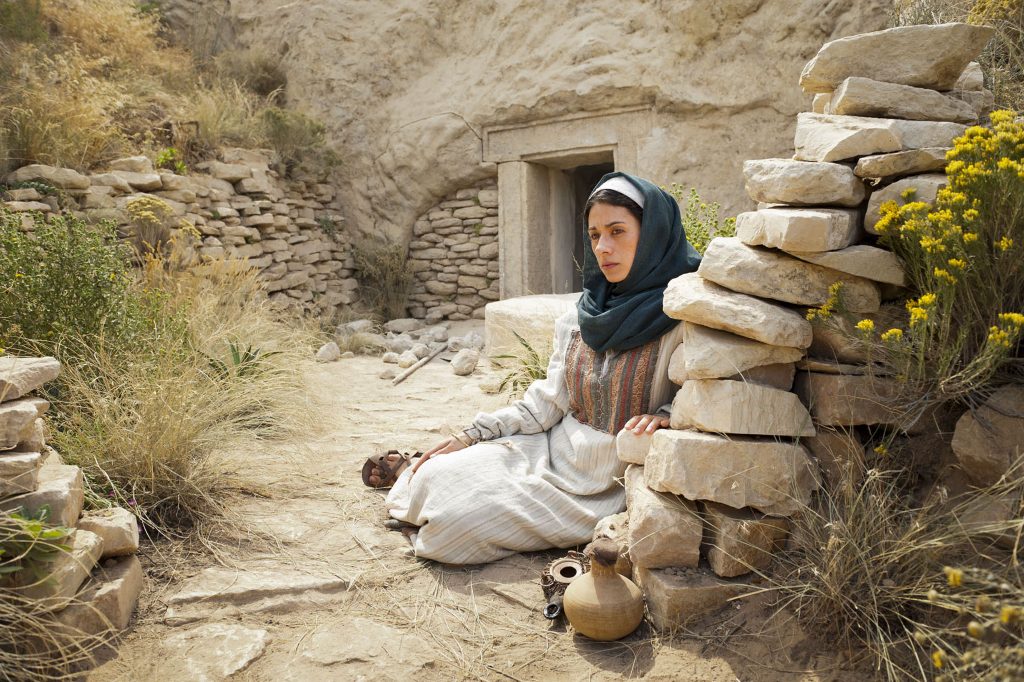
It all began with Mary Magdalene. Apparently
she was still in the shock/disbelieve period of the grieving process. She
visited Jesus’ tomb every morning before sunset (20:1). She may have been
looking for closure; however, perhaps something was strangely drawing her to
the now-empty tomb. Some have called this “female intuition.”[10] After realizing the tomb was indeed empty, she ran straightway to Peter and the other disciples and informed them of the empty tomb.
The men raced back to the empty tomb only to find grave clothes. Finally the men went back home but Mary would not leave. Mary wanted to give Jesus a proper Jewish burial and refused to be denied that right. At this moment two angels appeared to Mary asking, “Woman, why are you crying? Who is it you are looking for?” (v15). Then Jesus appeared but she did not recognize Him. She assumed that he was the gardener. Jesus asked her the same question adding “Who is it that you are looking for?” (v15). Mary first pleaded with the angels and then with Jesus over the body. This dogged disciple simply would not take no for an answer. Jesus finally answers: “Mary.” She responds by turning toward Him; she cried out in Aramaic, “Rabboni!” (which means “Teacher”) (v17). Rabbini
is less formal and more personal than the title “Rabbi.”[11] As N. T. Wright points
out, Jesus doesn’t call her by her Greek name Maria, instead He uses her Jewish name, Mariam.[12]
English Bibles do not catch this subtly. Could it be that there was something
about her name that made her immediately realize to whom she was speaking with? It is entirely possible that this was the name Jesus used as her nickname and she immediately caught on. It is also possible that Jesus was telling her that she would never be the same: the old Maria is gone; the new Marian is a new creature. At this point two people had believed in Christ and received a transformative spiritual experience, Mary and the believing disciple. However, this transformative message of a risen Savior will in years to come change the world. Jesus already had his “gardening suit” on illustrating His plan to set the world to rights, starting right in the garden where the problem started.[13] Instead of a dead body,
Mary found the most important and profound message the world will ever hear.
Jesus commissioned her to, “Go instead to my brothers and tell them, ‘I am ascending to my Father and your Father, to my God and your God’” (v17).
Let us back up a hair. In Jn 20:17, the beginning is profound and shows Mary’s love for Christ. Christ instructed Mary, “Do not hold on to me, for I have not yet ascended to the Father” (v17). She was holding on to the risen Christ “for dear life,”[14]
she was not about to let Him go easily. This passage shows her overpowering
love for her Savior, and likewise, His love for her. Teresa Okure points out that it seems like Jesus delayed His journey just to meet His foremost female disciple and give her this very important task.[15] As many have pointed out, a writer would not make this up since a woman could not be a witness in the first place. This fact adds credibility to the resurrection story!
How the disciples received The Message of a Resurrected Christ
The disciples who head the good news from Mary Magdalene did not believe her. First, it sounded like she was talking nonsense; perhaps she was hysterical. Strange things can happen in a time of great grief. From a Jew’s point of view, people did not get resurrected until the last day, never before. It made no sense to believe her testimony.
In contrast to Martha’s boldness, the disciples were
behind locked doors in fear of the Jewish leaders (v19). Despite the locked
doors, Jesus walked in among them and spoke “Peace be with you!” Afterwards, He displayed his nail-scarred hands and his pierced side. The disciples finally believed, except for Thomas, who did not even bother to show up at the meeting.
Thomas refused to believe the reports that Jesus has
risen from the dead. He balked, “Unless I see the nail marks
in his hands and put my finger where the nails were, and put my hand into his
side, I will not believe.” One week later, when Thomas joined the in the
meeting with the disciples, Jesus showed up again. Jesus demanded that Thomas
examine his hands and side. Afterwards, Thomas believed and proclaimed, “My
Lord and my God!” Finally Thomas got it! This was
Thomas’ conversion experience. Thomas finally understand that Jesus was no mere man, no talented Rabbi, not just a miracle maker, but God Himself standing in their mist. Thomas would never be the same.
Conclusion
Mary Magdalene has never been given
the credit she deserves for her faithfulness to Christ. Taking the portrait the Bible paints of her, this paper holds that
Magdalene was an independent, strong-willed, dogged follow of Christ. Her love for Christ made her fearless in the face of severe persecution and possible death. She loved the “rabbi” so much that she tried to never leave his side, even after His death. Although the culture in which she lived prohibited women from being witnesses of any kind, Jesus made her a witness to the greatest event in human history. Jesus himself bears out my theses: Mary was the most trustworthy and faithful of all of His disciples.
Bibliography
Keener,
Craig S. The IVP Bible Background Commentary: New Testament. First
edition. Downers Grove, Ill: IVP Academic, 1994.
O’Collins, Gerald. “Mary Magdalene as
Major Witness to Jesus’ Resurrection.” Theological Studies 48, no. 4
(December 1987): 631–46.
Okure, Teresa. “The Significance Today of
Jesus’ Commission to Mary Magdalene.” International Review of Mission
81, no. 322 (April 1992): 177–88.
Renfro, Kyndall. “Faithful Disciple,
Feminine Witness: Mary Magdalene Revisited.” Review & Expositor 110,
no. 1 (2013): 131–36.
Taylor, Joan E. “Missing Magdala and the
Name of Mary ‘Magdalene.’” Palestine Exploration Quarterly 146, no. 3
(September 2014): 205–23. doi:10.1179/0031032814Z.000000000110.
Thimmes, Pamela. “Mary Magdalene–Many
Portraits, Many Voices: Leadership, Memory and Conflict in Early Christianity.”
Proceedings (Grand Rapids, Mich.) 16 (1996): 1–15.
Wright, Nicholas. “Response: The Seattle
Pacific University Magazine.” Seattle Pacific University, 2005.
https://spu.edu/depts/uc/response/summer2k5/features/imagination.asp.
Wright, Nicholas. “The
Bible and Christian Imagination” (lecture, Seattle Pacific University, Seattle,
May 8, 2005), n.p., accessed April 22, 217,
https://spu.edu/depts/uc/response/summer2k5/features/imagination.asp.
